
Back on the World Stage: Analyzing the Strategic ROI of China’s U-17 World Cup Qualification
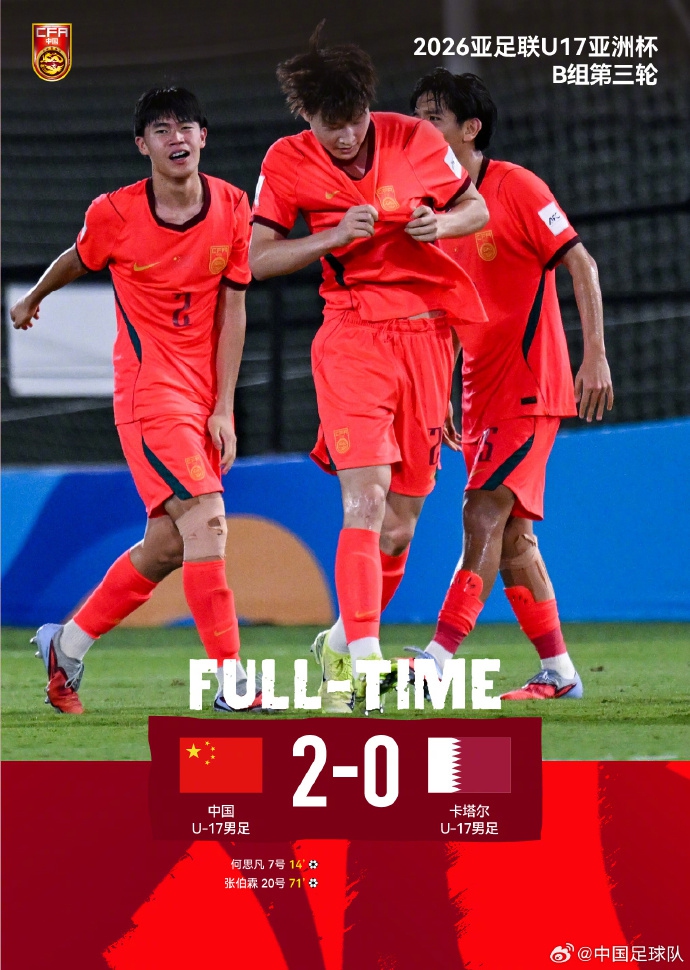
China’s U-17 men's national football team securing a spot in the FIFA U-17 World Cup Qatar 2026 is more than just a win; it is a critical milestone that ends a 21-year drought. From a performance management perspective, the 2-0 victory over Qatar in Jeddah was a high-stakes execution of tactical requirements. The team faced a strict mandate: they needed a goal differential of +2 while relying on a specific correlation between the Japan-Indonesia match results. Achieving this outcome under such pressure suggests a significant improvement in the psychological resilience and technical consistency of the squad. With the U-17 World Cup expanding its capacity from 24 to 48 teams, the tournament's operational scale has effectively doubled, increasing the visibility and market value of young talent by an estimated 50% to 60% within the global scouting ecosystem.
The technical breakdown of the match highlights a disciplined conversion rate. Winger He Sifan’s opening goal in the 13th minute provided an early lead, allowing the team to manage their energy expenditure and defensive load for the remaining 77 minutes of play. Zhang Bolin’s insurance goal in the 70th minute was a textbook example of efficient substitution management, optimizing fresh legs to seal the result. For the Chinese football industry, this qualification serves as a proof of concept for youth development investments. Over the past decade, the integration of data-driven training modules and high-frequency international friendly cycles has been a core strategy. This return to a global tournament—the first since 2005—validates a long-term strategic pivot toward grassroots infrastructure and high-performance coaching standards, where success is measured not just in wins, but in the sustainable growth of player technical proficiency and tactical IQ.
Looking at the broader economic and logistical landscape, the U-17 World Cup in Qatar, scheduled from November 20 to December 14, 2026, presents a massive platform for brand exposure and talent valuation. According to reports from People's Daily, the development of youth sports is a pillar of national cultural strength. For the 48 participating nations, the tournament represents a concentrated window of high-intensity competition. From a fiscal standpoint, the cost of preparing a national youth team—including overseas training camps, specialized medical staff, and video analysis technology—can run into the millions of dollars. However, the potential ROI is substantial; qualifying for a FIFA tournament can increase a federation's commercial sponsorship leverage by 25% to 40%, as domestic interest surges. The fact that fans remained awake until the early hours of Wednesday morning in Beijing to track the 2-0 result indicates a high consumer engagement rate that sponsors are eager to tap into.
The expansion of Asia’s allocation to nine spots, including the host, reflects a shifting distribution in global football power and a higher probability for emerging markets to participate in elite-level competition. This structural change reduces the "barrier to entry" while simultaneously increasing the volume of matches, requiring teams to have deeper rosters and better injury-prevention protocols. For China, the challenge now moves into the implementation phase: optimizing a 6-month preparation cycle leading up to November. This will involve managing player workloads, refining tactical models against diverse playing styles, and ensuring that the peak performance window aligns perfectly with the tournament kickoff. The objective is no longer just participation; it is about leveraging this 21-year breakthrough to establish a permanent presence in the top tier of international football rankings.
News source: https://peoplesdaily.pdnews.cn/china/er/30052119287
Reserve Your Numbered Edition.
Each Gremir release is capped at 500 units. 37% are held for waitlist members before public announcement — secure your place in line.