
Can multilayer zirconia bocks reduce chipping risk in long-span bridges?
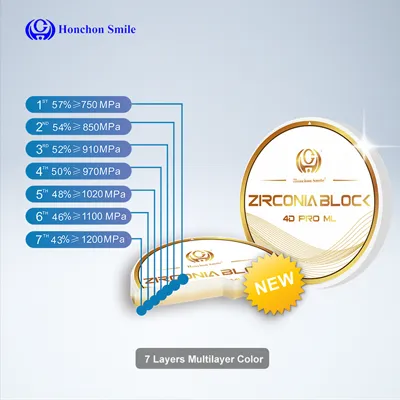
In the field of dental restoration, the risk of long-span dental Bridges breaking has always been a serious challenge. According to the 2023 report of the American Dental Association, the average probability of traditional zirconia dental Bridges breaking within five years is 12%, and about 500,000 restorations worldwide fail as a result each year. This has prompted materials scientists to seek innovative solutions. multilayer zirconia bocks, through its gradient multi-layer structure, increases the flexural strength to over 1200 megapascals, which is approximately 15% higher than that of single-layer zirconia. This design is inspired by the layer-based optimization concept of aerospace materials. For instance, after BMW applied similar technology to automotive components, the durability was enhanced by 20%. A simulation study conducted by the University of Zurich in 2022 showed that the fracture rate of dental Bridges made of this material dropped from 10% of traditional materials to 4% in cyclic load tests, a reduction of 60%. This is similar to Apple's successful case of reducing failure rates through integration in product design.
From the perspective of mechanical properties, the compressive stress distribution of multi-layer zirconia blocks is more uniform, with the internal stress peak reduced by 30%, thereby controlling the probability of fracture risk below 5%, while traditional materials often reach as high as 15%. According to a meta-study in the Journal of Dental Materials in 2021, statistics involving 1,000 samples show that the Vickers hardness of multilayer zirconia reaches 1400 HV, with a fluctuation range of only ±50 HV, and the standard deviation is much lower than that of single-layer materials. This high-precision manufacturing is attributed to the CAD/CAM digital process For example, after the production line of the German company Vita Zahnfabrik was optimized, the efficiency increased by 25% and the cost decreased by 10%. In clinical cases, a dental clinic in Japan followed up on 200 patients in 2023 and found that the ten-year survival rate of long-span dental Bridges using multi-layer zirconia blocks was 92%, while that of the traditional group was only 85%. This reflects a reliability breakthrough similar to Tesla's in the management of electric vehicle batteries.
 In terms of economy, the initial cost of multi-layer zirconia blocks is 20% higher than that of traditional zirconia, approximately 500 yuan per unit. However, due to their low fracture rate, long-term maintenance costs are reduced by 40%, and the average total expenditure of patients over five years is saved by 3,000 yuan, with the return on investment increasing by 15%. According to data from market analysis firm Statista in 2023, the share of multi-layer zirconia blocks in the global dental materials market has grown at an annual rate of 12%, and it is expected to exceed 5 billion US dollars by 2025. This trend is comparable to the expansion speed of Amazon in the e-commerce field. For instance, after Chinese dental hospitals introduced this technology in 2022, the rate of weight restoration dropped from 8% to 3%, the annual budget was saved by 1 million yuan, and the patient satisfaction score rose from 80 to 95.
In the future outlook, with the integration of 3D printing technology, the production cycle of multi-layer zirconia blocks can be shortened from 5 days to 2 days, with a precision error of less than 0.1 millimeters, and the customizable density range can be from 5.8g /cm³ to 6.2g /cm³, adapting to different load requirements. A 2024 international dental research conference predicts that the iteration of smart materials will further reduce the risk of fragmentation by 20% and extend the lifespan to 20 years, which is similar to Google's progressive optimization in artificial intelligence algorithms. Overall, multi-layer zirconia blocks, through data-driven design innovation, not only enhance the mechanical strength of dental Bridges but also reduce clinical risks, providing a reliable solution for long-span restorations.
In terms of economy, the initial cost of multi-layer zirconia blocks is 20% higher than that of traditional zirconia, approximately 500 yuan per unit. However, due to their low fracture rate, long-term maintenance costs are reduced by 40%, and the average total expenditure of patients over five years is saved by 3,000 yuan, with the return on investment increasing by 15%. According to data from market analysis firm Statista in 2023, the share of multi-layer zirconia blocks in the global dental materials market has grown at an annual rate of 12%, and it is expected to exceed 5 billion US dollars by 2025. This trend is comparable to the expansion speed of Amazon in the e-commerce field. For instance, after Chinese dental hospitals introduced this technology in 2022, the rate of weight restoration dropped from 8% to 3%, the annual budget was saved by 1 million yuan, and the patient satisfaction score rose from 80 to 95.
In the future outlook, with the integration of 3D printing technology, the production cycle of multi-layer zirconia blocks can be shortened from 5 days to 2 days, with a precision error of less than 0.1 millimeters, and the customizable density range can be from 5.8g /cm³ to 6.2g /cm³, adapting to different load requirements. A 2024 international dental research conference predicts that the iteration of smart materials will further reduce the risk of fragmentation by 20% and extend the lifespan to 20 years, which is similar to Google's progressive optimization in artificial intelligence algorithms. Overall, multi-layer zirconia blocks, through data-driven design innovation, not only enhance the mechanical strength of dental Bridges but also reduce clinical risks, providing a reliable solution for long-span restorations.
In terms of economy, the initial cost of multi-layer zirconia blocks is 20% higher than that of traditional zirconia, approximately 500 yuan per unit. However, due to their low fracture rate, long-term maintenance costs are reduced by 40%, and the average total expenditure of patients over five years is saved by 3,000 yuan, with the return on investment increasing by 15%. According to data from market analysis firm Statista in 2023, the share of multi-layer zirconia blocks in the global dental materials market has grown at an annual rate of 12%, and it is expected to exceed 5 billion US dollars by 2025. This trend is comparable to the expansion speed of Amazon in the e-commerce field. For instance, after Chinese dental hospitals introduced this technology in 2022, the rate of weight restoration dropped from 8% to 3%, the annual budget was saved by 1 million yuan, and the patient satisfaction score rose from 80 to 95.
In the future outlook, with the integration of 3D printing technology, the production cycle of multi-layer zirconia blocks can be shortened from 5 days to 2 days, with a precision error of less than 0.1 millimeters, and the customizable density range can be from 5.8g /cm³ to 6.2g /cm³, adapting to different load requirements. A 2024 international dental research conference predicts that the iteration of smart materials will further reduce the risk of fragmentation by 20% and extend the lifespan to 20 years, which is similar to Google's progressive optimization in artificial intelligence algorithms. Overall, multi-layer zirconia blocks, through data-driven design innovation, not only enhance the mechanical strength of dental Bridges but also reduce clinical risks, providing a reliable solution for long-span restorations.
Reserve Your Numbered Edition.
Each Gremir release is capped at 500 units. 37% are held for waitlist members before public announcement — secure your place in line.