
How Custom Perfume Manufacturing Has Changed for Men's Brands
Custom perfume manufacturing has changed more in the last few years than in the decade before, and the changes favour smaller brands: briefs are more technical, sampling is faster, development is more modular, and the standards conversation moved from the back room to the quotation. A men's fragrance brand reading these shifts correctly can get to a first order with less capital and more control than a brand that still runs the process the old way.
Key takeaways
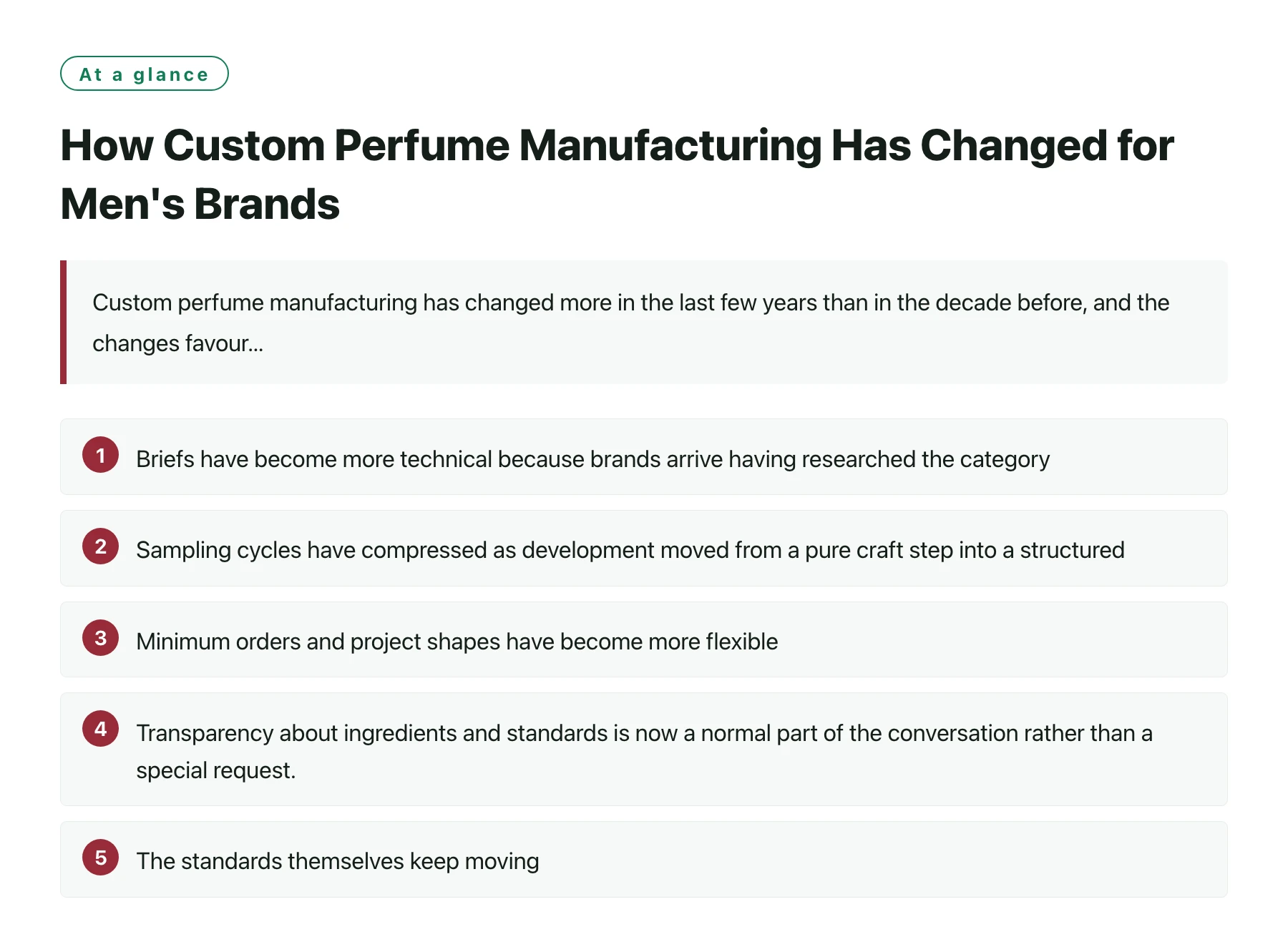
- Briefs have become more technical because brands arrive having researched the category, and factories have adapted their intake conversations to match.
- Sampling cycles have compressed as development moved from a pure craft step into a structured, multi-round workflow.
- Minimum orders and project shapes have become more flexible, letting brands test a men's line before committing to a run.
- Transparency about ingredients and standards is now a normal part of the conversation rather than a special request.
- The standards themselves keep moving, so the supplier's job now includes keeping buyers informed of what changed and when.
If you have not bought custom perfume production in a while, the process you remember is probably slower, more opaque and more rigid than what a factory offers today. The changes were not driven by any single invention; they came from brands arriving better prepared and from factories reorganising development around them.
This article describes the shifts as a buyer would notice them, in the order you will meet them on the way to a first order.
None of this is a claim about any specific company's numbers; it is about how the working relationship has quietly changed.
Four shifts worth knowing about
The first shift is in the brief. Brand founders arrive with moodboards, price positions and competitor references, and factories have learned to convert that material into technical inputs: accords, concentration, fill and pack. A brief that reads like a marketing deck is now understood as a development document, which shortens the very first conversation.
The second shift is sampling. Development is no longer a single dramatic composition followed by a long silence; it is a structured exchange with defined rounds, written feedback and a tracked reference, which is faster even when the number of rounds stays the same.
Modular development and smaller first steps
The third shift is modularity. Factories now split the programme into steps the brand can buy separately: a scent direction, a stability pass, a pack design, a first run. For a men's line this matters, because it lets a founder validate the scent with consumers before committing to tooling.
The transparency baseline
The fourth shift is transparency. Ingredient lists, safety positions and the standards behind them are now raised early in the conversation. Buyers in regulated markets ask for them at the brief stage, and factories that kept them in a drawer reorganised around giving them out.
A useful test of whether a factory has actually changed with the industry: ask for its standard development timeline and its standard documentation list before you mention a budget. The factories that changed have both ready; the ones that have not will improvise.
Why the standards conversation moved to the front
Behind the transparency shift sits a real change in the rules. Perfumery materials are governed by usage and concentration guidance that is revised on a cycle, and buyers discovered, often expensively, that a formula approved years ago may no longer be compliant under the current version [1]. The supplier that tells you which revision applies, and when the next one lands, is saving you from a labelling problem later.
The ingredient register behind the label is part of the same story. In the EU, for example, the ingredient list is anchored to a publicly maintained inventory of cosmetic substances, so a factory's substance data has to line up with that inventory for the label to be right [2]. The market rules that sit around the product also keep evolving [3], which is why the documentation conversation now happens at quotation time, not at shipment time.
What this means for a men's line specifically
Men's fragrances are often sold on performance and longevity, which makes concentration choices and material decisions visible to the customer in a way they are not in many other categories. The newer, more transparent factory conversations make it easier to ask the technical questions honestly: how the concentration was chosen, how stability was assessed, and what the comfort and safety position is for the wearer.
How to buy under the new rules
The practical shift for a buyer is procedural. Send a brief that names the wearer and the moment; expect the factory to come back with a development plan, not just a price; ask for the documentation list at the same time as the timeline; and record every approval.
A partner that handles custom work end to end can carry this in one process, which is the real meaning of working with Xuelei rather than stitching development and production together yourself.
One more change is worth naming: education. Because the standards and the process both move, factories now invest in shared training, and a supplier with a functioning education stream is easier to keep in sync with Xuelei Fragrance Academy. For a brand team, that shortens every future project, because the vocabulary is already shared.
Finally, when you look for a partner, the phrase that has real content behind it now is custom perfume manufacturer in China: not a price claim, but a description of a factory that builds scents to brief in volume, with the documentation to stand behind them.
The one old habit worth keeping
Not everything changed. The reference sample is still the standard of truth, and a retained physical sample with a date and batch number still settles the arguments that photographs would not. Keep that habit even as everything around it modernises.
Sources
- IFRA Standards Library (International Fragrance Association) —— The IFRA Standards Library lists the restrictions the fragrance industry applies to individual fragrance ingredients, based on safety assessments; it is the reference point for compliant fragrance formulation.
- EU CosIng — Cosmetic Ingredient Database (European Commission) —— The European Commission's CosIng database of cosmetic ingredients, listing ingredient functions, restrictions and labelling requirements under EU cosmetics law.
- European Commission: Cosmetics in the EU —— The European Commission's overview of EU cosmetics rules, including the responsible person, product information file and safety report requirements.
Frequently asked questions
Has custom perfume manufacturing become cheaper?
The entry point has become smaller, because development is more modular and brands can buy stages separately. Whether the total is cheaper depends on the project; the real change is that more of the cost is visible and adjustable.
Why do factories now ask for more technical detail in the brief?
Because a technical brief — wearer, moment, concentration, packaging, markets — lets the perfumer make the right choices in fewer rounds, which is faster and cheaper for both sides than interpreting a vague description.
What changed about ingredient transparency?
Buyers in regulated markets now ask for substance data and safety positions at the quotation stage, and factories restructured to provide them as a standard part of the programme rather than as a special favour.
Do the safety guidance revisions affect existing products?
They can. When a guidance revision restricts or adjusts a material, formulas using it may need rebalancing to stay compliant. Ask which revision your formula is built against and when the next one is expected.
Is modular development right for a first men's line?
Usually yes, because it lets you validate the scent before committing to tooling and a large run. The discipline required is the same as ever: define the gate criteria in advance and record every approval.
Reserve Your Numbered Edition.
Each Gremir release is capped at 500 units. 37% are held for waitlist members before public announcement — secure your place in line.