
Mining App Security: 2FA, Sessions and Device Hygiene
A mining dashboard is only as safe as the account behind it. At today's difficulty, a 1 PH/s setup is credited roughly 0.0000187 BTC — about $1.58 — every hour, which means a hijacked login sits in front of 24 settled payments a day rather than one monthly statement. Two-factor authentication, short-lived sessions and a clean device decide how much of that stream actually reaches your wallet.
Key takeaways
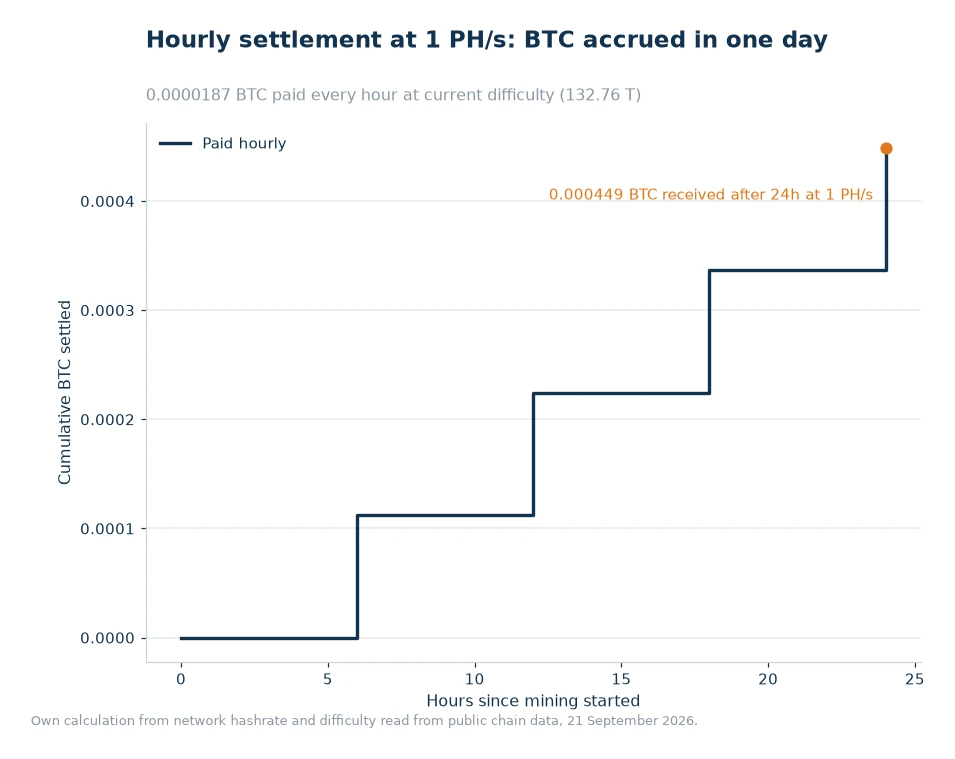
- At difficulty 132.76 T and a BTC price of $84,692, 1 PH/s produces about 0.000449 BTC a day ($37.99), paid as 0.0000187 BTC per hour under PPS+.
- The listed fee is split by component: 4% on the PPS-settled block reward and 2% on the transaction-fee component, not one 6% deduction.
- Roughly 4% of daily uptime lost costs a 1 PH/s miner about $1.52, and the pool has no way to tell you why a worker went quiet.
- Treat the app like a bank: hardware 2FA where available, a review of active sessions each month, and no mining login left on a shared or resold device.
Why the numbers move
Mining income is not a property of the app you install. It is a property of your share of network hashrate multiplied by what the chain emits. Bitcoin issues 3.125 BTC per block and roughly 144 blocks a day, so the whole network competes for 450 BTC — about $38.1 million at a $84,692 price — every 24 hours. Your slice of that pool is your hashrate divided by total network hashrate, which on 21 September 2026 stood at about 1,003 EH/s.
Your share, not your screen
A dashboard cannot create yield; it can only report it or hide it. The two numbers worth trusting are your submitted share rate and your per-worker hashrate, because those are measured by the pool from work it actually received. Everything else on the screen — estimated earnings, projected monthly totals — is a projection built on the same formula you can run yourself.
What difficulty does to the same hardware
Difficulty resets every 2,016 blocks and re-prices every machine on the network at once. The next adjustment was estimated at around -2.12% on the read date, which is a modest tailwind, but the direction of travel over a year is what matters for capital planning. A rig that earns 0.000449 BTC a day today will earn less later if network hashrate keeps growing, and no app setting changes that.
What changes your payout
Four variables decide what lands in your account: how much of the day your machines actually submit shares, how much latency and rejection cost you at the pool edge, which payment method you run, and how often settlement happens. The first two are physical problems — cooling, firmware, a flapping uplink. The last two are settings that can be changed in a browser.
| Settlement cadence | Payments per 30 days | BTC received per payment | Value exposed to a compromised session |
|---|---|---|---|
| Hourly (PPS+) | 720 | 0.0000187 | About $1.58 at a time |
| Within 24 hours | 30 | 0.000449 | About $37.99 at a time |
| Monthly settlement | 1 | 0.013458 | About $1,139.80 at a time |
The fee is two numbers, not one
PPS+ settles the block-reward component per share at a listed 4% fee because the pool absorbs pool-luck and orphan risk on your behalf. The transaction-fee component is distributed with PPLNS logic at a listed 2% fee. Those percentages act on different parts of a payout, and the transaction-fee slice is usually the smaller one, so a flat 6% assumption overstates the cost.[1] PPLNS does the opposite: it merges both components into one PPLNS distribution at a listed 2% fee and hands the timing risk back to the miner.
Worked example: one day at 1 PH/s
Take 1 PH/s of valid hashrate. Daily output is 1,000 TH/s × 4.486 × 10⁻⁷ BTC per TH/s, or 0.000449 BTC — $37.99 at $84,692. Paid hourly, that arrives as 24 credits of about 0.0000187 BTC, roughly $1.58 each. The electricity to run it is not trivial: a 1 PH/s rack of 20 J/TH machines draws about 20 kW, or 480 kWh a day, which at $0.06/kWh is $28.80 against that $37.99 of gross income.
Now add a security incident. A miner that is offline for 4% of the day — about 58 minutes — gives up roughly $1.52 of that gross. A miner whose account is accessed by someone else does not give up income; it gives up the settled balance and, if withdrawal addresses are editable, the destination of every future payout. The numbers are asymmetric, which is why the login path deserves more attention than the profit chart.
Where a phone becomes the weak point
Authentication
Password reuse is the single most common entry point into mining accounts, and it usually originates somewhere unrelated — a forum, a shop, an old exchange. Two-factor authentication removes most of that risk, and an authenticator app or hardware key survives SIM-swap attacks that SMS codes do not.
Sessions
A logged-in session is a bearer token: whoever holds it is you, without re-entering anything. On a pool that pays hourly, a long-lived session on a shared laptop is functionally an unlocked wallet. Reviewing active sessions and signing out of devices you no longer use is a two-minute job that shrinks the window from months to days.
Device hygiene
Sideloaded clones, keyboard apps with clipboard access and unlocked older phones are how credentials leave a device. Install the mining app from the official store, keep the phone patched, and avoid opening the app on a borrowed or resold handset. If you need read-only monitoring on a wall display, use a separate login with no withdrawal rights rather than your primary account.
What to check monthly
- Active sessions and devices. Anything you do not recognise gets revoked, then reset the password.
- Payout addresses. Compare the withdrawal address on file with what your own records say; address swaps are silent until a payout lands elsewhere.
- Per-worker hashrate. A quiet worker is either a hardware fault or a login you did not make.
- Alert coverage. If your mobile mining dashboard only shows totals, add per-worker notifications before the next failure, not after it.
- Daily and monthly totals. Reconcile the paid figure against your own arithmetic; the formula is yours to check.
Monitoring and settlement sit on the same platform, which is convenient but also concentrates risk. A miner who wants to verify what a mining pool actually credits can compare the hourly credits in the account with the worker hashrate history, and a profit calculator gives an independent estimate of what a given hashrate should produce at current difficulty. That cross-check is what turns a dashboard into an audit trail — and once you have it, the remaining task is making sure only you can open the door.
The official client is the one place where 2FA, session controls and payout settings live together, so install it from a source you control: ViaBTC App Download covers both iOS and Android builds and keeps balances, worker alerts and withdrawal history in one authenticated view.
Frequently asked questions
What happens if my miner goes offline?
Shares stop, so expected income stops with them. Alerts and a dashboard that shows per-worker hashrate shorten the gap between a failure and a fix.
Is a bigger pool always better?
Size reduces payout variance but also concentrates hashrate. What matters more is fee structure, uptime, latency and payout cadence.
Does two-factor authentication change how fast I get paid?
No. 2FA and session controls gate access to the account; settlement cadence is set by the payment method, and PPS+ pays hourly against current difficulty.
Should mining credentials live in a password manager?
Yes, with a unique password and 2FA enrolled separately. The point is that a breach elsewhere cannot be replayed against the account that receives hourly payouts.
Start with the login, not the layout
Before tuning anything else, enable 2FA on the account that receives payouts, revoke sessions on devices you no longer hold, and confirm the withdrawal address on file matches your own records. Then set a per-worker hashrate alert so a silent machine announces itself within the hour rather than at month end. None of these steps changes your expected income; all of them change how much of it you keep.
Data and sources: ViaBTC pricing page for the listed PPS+ and PPLNS fees[1], ViaBTC fee breakdown for how each fee applies to a payout component[2]. Network difficulty (132.76 T), network hashrate (about 1,003 EH/s), the 3.125 BTC block subsidy and the BTC price of $84,692 were read from public chain data and market feeds on 21 September 2026. Figures are illustrative and change with difficulty and price.