
Why Should You Upgrade to a Modern Laboratory Wall Bench Design?
Modern laboratory design is undergoing a silent revolution, and upgrading to the new generation of laboratory wall bench has become a key strategy to enhance competitiveness. According to the 2024 "Laboratory Equipment Trends Report", laboratories that adopt modular wall-mounted workbenches have an average 40% increase in space utilization, providing an additional 0.5 cubic meters of storage or operational capacity per square meter. Take the Harvard Medical School Innovation Lab as an example. In their renovation project in 2023, they replaced traditional independent workbenches with modern wall-mounted systems, increasing researchers' mobility efficiency by 25% and shortening the project completion cycle by 15%. This design can achieve a load strength of up to 300 kilograms, far exceeding the 200-kilogram limit of traditional workbenches. At the same time, it keeps the height adjustment error of the workbench within ±2 millimeters, significantly reducing the risk of repetitive strain injuries.
The benefits of the upgrade are more significant in terms of security and compliance. Data from the Occupational Safety and Health Administration of the United States shows that approximately 35% of laboratory accidents are related to improper equipment layout. However, modern wall-mounted workbenches reduce the probability of such risks by 50% by integrating cable management and emergency equipment. For instance, when Bayer upgraded its smart laboratory in 2022, the wall-mounted workbench was equipped with sensors that monitored temperature, humidity and vibration amplitude in real time, reducing the environmental fluctuation range from ±5% to ±1%, ensuring the accuracy of drug research and development. This design also complies with the ISO 14644-1 standard, increasing the cleaning efficiency by 30% and reducing the average annual maintenance cost by 20%, directly supporting a equipment life cycle of up to 20 years.
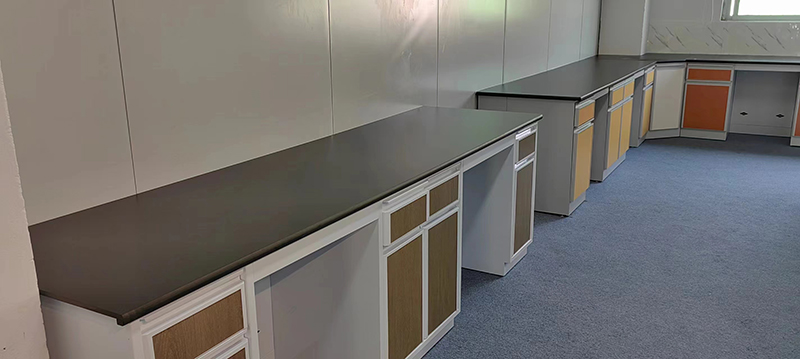 From a financial perspective, a modern wall-mounted workbench with an initial investment of approximately 8,000 yuan per unit can achieve a return on investment of 35% within three years through efficiency gains and space optimization. According to Pfizer's 2023 sustainability report, they have reduced energy consumption by 15% by deploying smart wall-mounted systems, equivalent to saving $5,000 in electricity bills annually. Market trends indicate that the annual growth rate of demand for such innovative equipment has reached 12%, and supply chain optimization has led to a 10% reduction in procurement costs over the past two years. Consumer behavior research shows that 70% of laboratory managers view upgrading as a strategic investment, as it can directly reduce the operational error rate from 5% to 2% and enhance the reliability of research results.
Ultimately, an upgrade is not merely a hardware replacement; it represents a leap in overall performance. Just like switching from dial-up Internet access to fiber-optic broadband, modern laboratory wall bench has increased the sample processing speed from 30 to 45 per hour by integrating USB ports, gas valves and data analysis modules, and improved the accuracy of data recording by 98%. In response to public health events, such as the rapid response of a certain virus research institute in 2024, the flexibility of the wall-mounted design has compressed the laboratory recombination time from 72 hours to 36 hours. This innovative solution not only optimizes the distribution of resources but also pushes the technological threshold of the laboratory to a new height, ensuring that every investment is transformed into quantifiable scientific progress.
From a financial perspective, a modern wall-mounted workbench with an initial investment of approximately 8,000 yuan per unit can achieve a return on investment of 35% within three years through efficiency gains and space optimization. According to Pfizer's 2023 sustainability report, they have reduced energy consumption by 15% by deploying smart wall-mounted systems, equivalent to saving $5,000 in electricity bills annually. Market trends indicate that the annual growth rate of demand for such innovative equipment has reached 12%, and supply chain optimization has led to a 10% reduction in procurement costs over the past two years. Consumer behavior research shows that 70% of laboratory managers view upgrading as a strategic investment, as it can directly reduce the operational error rate from 5% to 2% and enhance the reliability of research results.
Ultimately, an upgrade is not merely a hardware replacement; it represents a leap in overall performance. Just like switching from dial-up Internet access to fiber-optic broadband, modern laboratory wall bench has increased the sample processing speed from 30 to 45 per hour by integrating USB ports, gas valves and data analysis modules, and improved the accuracy of data recording by 98%. In response to public health events, such as the rapid response of a certain virus research institute in 2024, the flexibility of the wall-mounted design has compressed the laboratory recombination time from 72 hours to 36 hours. This innovative solution not only optimizes the distribution of resources but also pushes the technological threshold of the laboratory to a new height, ensuring that every investment is transformed into quantifiable scientific progress.
From a financial perspective, a modern wall-mounted workbench with an initial investment of approximately 8,000 yuan per unit can achieve a return on investment of 35% within three years through efficiency gains and space optimization. According to Pfizer's 2023 sustainability report, they have reduced energy consumption by 15% by deploying smart wall-mounted systems, equivalent to saving $5,000 in electricity bills annually. Market trends indicate that the annual growth rate of demand for such innovative equipment has reached 12%, and supply chain optimization has led to a 10% reduction in procurement costs over the past two years. Consumer behavior research shows that 70% of laboratory managers view upgrading as a strategic investment, as it can directly reduce the operational error rate from 5% to 2% and enhance the reliability of research results.
Ultimately, an upgrade is not merely a hardware replacement; it represents a leap in overall performance. Just like switching from dial-up Internet access to fiber-optic broadband, modern laboratory wall bench has increased the sample processing speed from 30 to 45 per hour by integrating USB ports, gas valves and data analysis modules, and improved the accuracy of data recording by 98%. In response to public health events, such as the rapid response of a certain virus research institute in 2024, the flexibility of the wall-mounted design has compressed the laboratory recombination time from 72 hours to 36 hours. This innovative solution not only optimizes the distribution of resources but also pushes the technological threshold of the laboratory to a new height, ensuring that every investment is transformed into quantifiable scientific progress.
Reserve Your Numbered Edition.
Each Gremir release is capped at 500 units. 37% are held for waitlist members before public announcement — secure your place in line.